Whether you've just brought home a puppy or you've had the same dog for years and the coat has finally caught up with you, a first professional groom can feel like a big decision. It doesn't have to be.
In England, dog grooming is unregulated and there is no legal requirement for groomers to hold any qualifications, and Scotland is in the same position (more on Scotland below). That means there is no official stamp of approval to point at, and the checking is up to you.
This guide is a plain-English run-through for first-timers of any age. It covers what happens on the day, how to prepare your dog for grooming at home, and a short checklist for choosing a groomer you can trust.
Why the first visit matters
The pattern you set on the first visit tends to stick. A rough first groom can make the next one harder, and a calm first visit gives you something solid to build on.
Early, calm, positive grooming can set the pattern that makes future visits easier. The PDSA advises introducing grooming young, slowly and with rewards, so your dog is used to it and feels comfortable. The RSPCA says what a puppy learns and experiences in their first months will shape their future behaviour, and grooming is among the experiences to introduce gently. That holds for puppies and adult first-timers alike, which is why it's worth spending a few days on preparation even when your dog is grown.
When to book
Puppies: let the vaccinations lead
A puppy's first groom comes down to their jabs. Puppies should ideally start their primary vaccinations at around 6-8 weeks old, with two injections 2-4 weeks apart. They will be fully protected 2-4 weeks after the final injection, and some puppies need a third injection.
If you do the arithmetic, that puts most puppies fully protected somewhere around 12-16 weeks old (a bit later if your puppy needs a third injection). That's our working inference from the vaccination schedule above, not a PDSA instruction, but it's a sensible window to book a first, gentle "taster" groom.
Adult first-timers
Rescued dogs, ex-home-groomed adults and dogs who simply get worked up around handling have no vaccination constraint at all. Book whenever you feel ready.
For an adult meeting a groomer for the first time, ask about a short "taster" visit, typically around 20 to 45 minutes. Keep it short, end on a positive note, and build up over a couple of visits. The aim of the first session is a manageable experience, not a flawless finish.
Preparing at home
Match brushing to the coat
A bit of home brushing before the big day takes the load off the groomer and makes the visit calmer. The rough rule is that the longer or woollier the coat, the more often it needs attention: long or woolly coats may well need a brush through every day, while a short coat is often fine once a week.
Whatever the coat, don't let tangles build up before the visit. Mats pressed in near the skin are harder to work out, and they can turn a routine groom into a longer, more stressful one. If you're not sure which tool suits your dog's coat, our guide to dog grooming brushes in the UK is a good place to start.
Nails and routine
If you're comfortable trimming nails at home, keep them short enough that the visit is lighter rather than a rescue operation. If you're still deciding between a grinder and clippers, we compare the two in dog nail grinder vs clippers.
On the day itself, keep the routine as normal as you can. Feed at the usual time and don't layer on other changes, like a new walk route, at the same time. A familiar routine is a calmer dog.
What happens on the day
A typical groom, in order
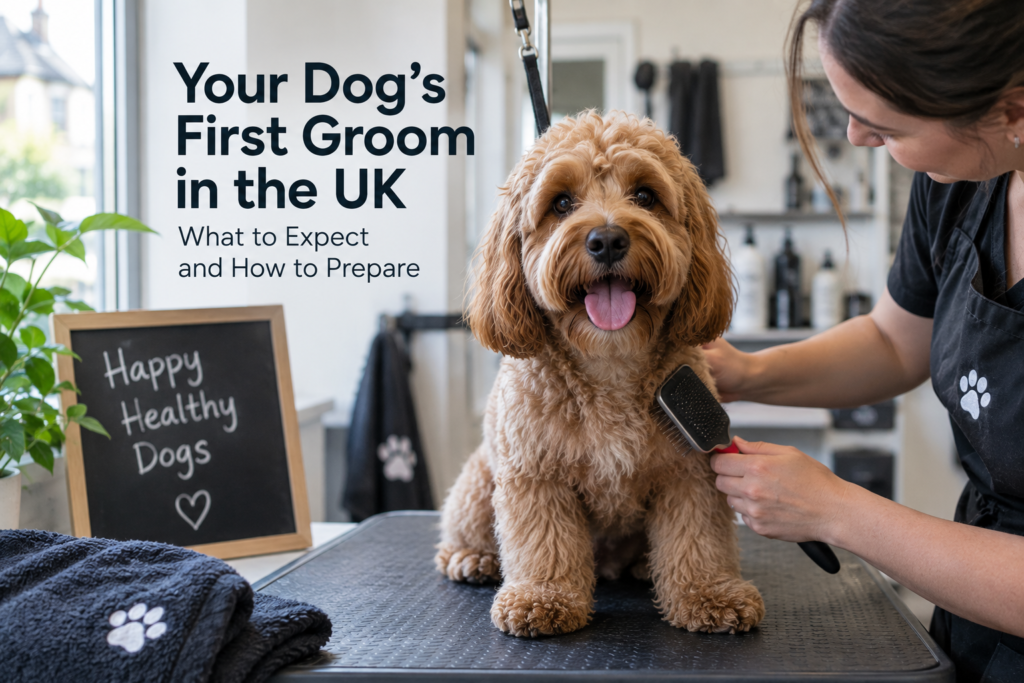
Most full grooms follow a similar order. Your groomer will usually start with a quick health check of the skin, ears and coat, then move on to a bath, a thorough dry, a trim to the agreed style, and a tidy-up of the nails and ears.
Dogs with long or woolly coats often get clipped before the bath so tangles can be worked out and the coat stays manageable while it's wet. Not every groom includes ear plucking or sanitary trimming. Those aren't automatic, so it's worth asking what the price covers before you book. We'll come back to that in the questions section below.
How long it takes
First visits are often kept deliberately short, and a full groom commonly takes 1.5 to 4 hours, depending on your dog's size and coat. If you're planning your day around it, budget generously, and ask the groomer how long your dog's coat typically takes.
Stress signals to know
Dogs rarely tell you they're stressed straight out. Look for yawning, lip-licking, turning the head away, crouching, a tucked tail, the whites of the eyes showing (so-called whale eye), pacing and shivering. If you see these, it's reasonable to ask the groomer to pause and give your dog a break. A groomer who knows their craft will do the same.
How to judge a groomer you can trust (UK context)
There's no licensing regime to lean on, so you do the vetting yourself. Here's what to check.
What to look for
The RSPCA recommends using a groomer with recognised qualifications. The most recognised route in the UK is the City & Guilds qualification, and the RSPCA asks owners to ask to see any certificates. It also recommends choosing a groomer who belongs to a trade organisation such as the British Dog Groomers' Association (BDGA), which accredits groomers to a set standard.
Insurance is a sensible thing to ask about too. It's common best practice, but not a legal requirement.
The legal backstop
The absence of a licensing regime doesn't mean the total absence of law. In Scotland, under the Animal Health and Welfare (Scotland) Act 2006, a groomer is responsible for the welfare of any animal while in their care and must ensure that they are protected from unnecessary suffering.
Scotland is also further along on licensing. The Scottish Government ran a consultation in 2023 on licensing the profession, and 82.2% of the 428 respondents to the dog grooming question supported it. As of September 2026, no licensing scheme has been brought into force.
Price reality
Professional dog grooming in the UK costs roughly £40-£50 for a standard appointment. The PDSA cited the average cost of a dog grooming appointment as "around £43" in a March 2023 article, so treat that figure as an indication rather than a current average. Prices vary a lot depending on your dog's size, coat type, the condition of the coat and which services are included, and they tend to be higher in London and the South East. Always ask for the price before you book.
What to ask the groomer
A good groomer will welcome these questions. It's a fair test of whether you're in capable hands.
- What qualifications or trade membership do you hold, and may we see the certificates?
- What does the health check at the start cover?
- How do you handle it if a dog starts to show stress signals?
- What does the price include, and what would add to it?
Things to question, not assume
Anal-gland expression is the obvious one. It's not something to assume is part of a standard groom. Anal-gland expression and anything medical is a veterinary procedure, so leave it to your vet or vet nurse. If your groomer offers it anyway, ask what it involves and whether it's needed for your dog.
Ear plucking works the same way. Ask before you assume, and ask why it's being done for your dog.
Coat-specific questions
If you have a double-coated breed such as a Retriever, Husky or German Shepherd, it's worth asking about brushing and de-shedding rather than shaving, since the outer coat is doing real work for your dog.
Doodle and spaniel-type coats, the Cockapoo, Labradoodle and Goldendoodle sort, often need clipping on a 4 to 8 week cycle. Ask your groomer for a plan for between visits, so you know what to expect and roughly when you'll need to come back.
After the visit
Note down what was actually done and what the groomer suggested for between visits. If anything felt off, a calm debrief with the groomer is sensible. Ask what they saw and what they'd do differently next time. A good groomer will answer without bristling.
The right groomer welcomes questions, on the day and after. Use them.